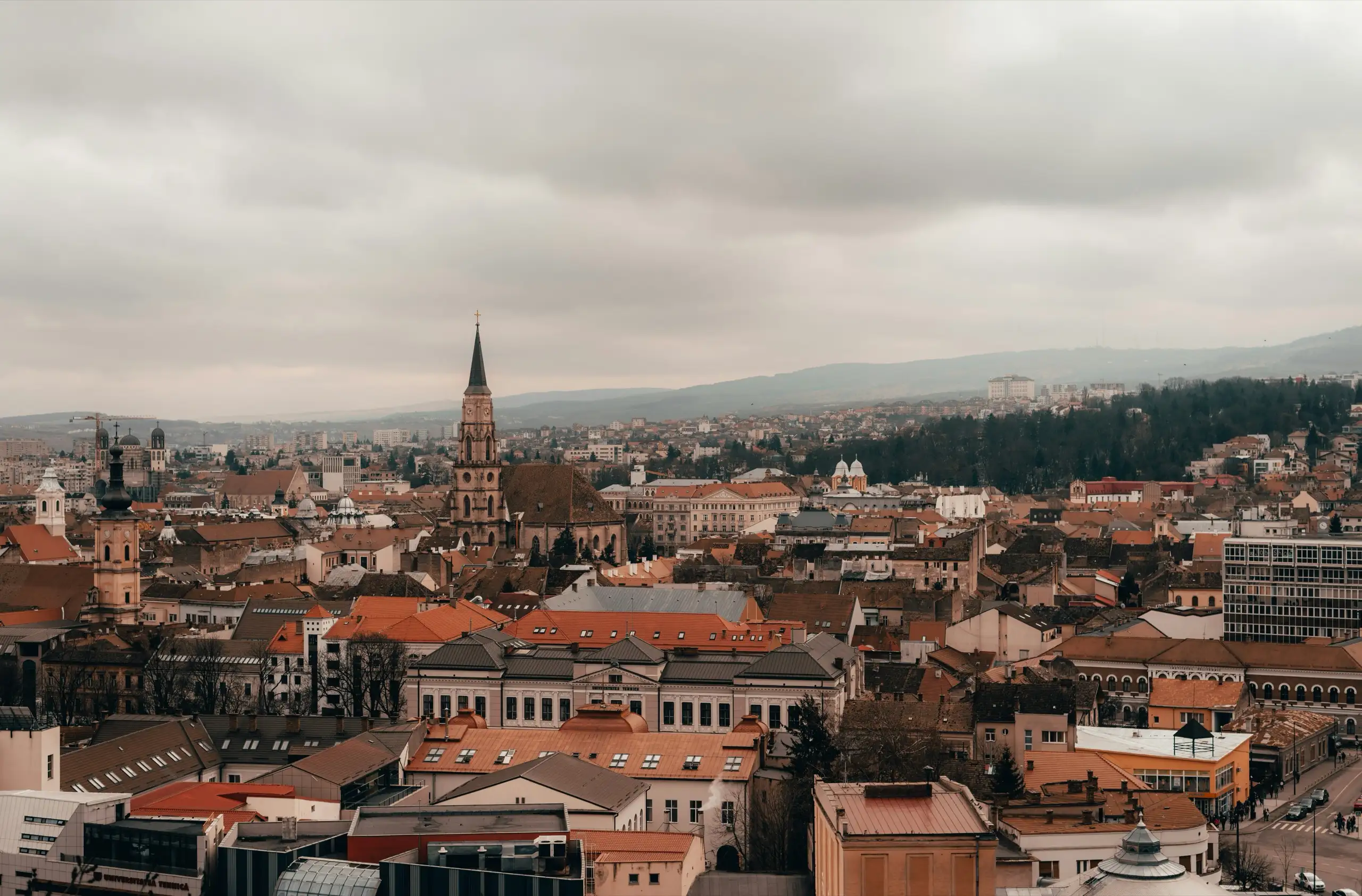
Most people planning a motorcycle trip in Romania start with a road: the Transfăgărășan (DN7C), the Transalpina (DN67C), the gravel of the Apuseni. Then they book a flight to Bucharest because it has the biggest airport, and spend the first and last day of the trip crossing flat farmland to reach the roads they came for.
Here is the thing the flight search does not show you. The airport you land at matters far less than where the mountains start. Romania has three realistic cities to start a rental from, and only one of them has mountain roads inside the first hour. That city is Cluj-Napoca. Fly into Cluj and you can ride everything, and this is the case for it, with the fair version of the other two so you can decide for yourself.
The Three Cities at a Glance
Road distances are approximate, measured from the city to the point you actually ride to: Bâlea Lake for the Transfăgărășan, Rânca for the Transalpina, Padiș for the Apuseni, Baia Mare for Maramureș and Vatra Dornei for Bucovina.
| Cluj-Napoca | Bucharest | Brașov | |
|---|---|---|---|
| Airport | Cluj International (CLJ), Romania’s second-busiest | Henri Coandă (OTP), the largest by far | Brașov-Ghimbav (GHV), opened 2023, few routes |
| Airport to rental base | 20 minutes | in the city, 30 to 60 minutes | in the city |
| First mountain road | Under 1 hour | Curtea de Argeș, about 2 hours | Bran and Râșnov, 30 minutes |
| Transfăgărășan | ~250 km | ~220 km | ~130 km |
| Transalpina | ~230 km | ~250 km | ~200 km |
| Apuseni Mountains | ~100 km | ~400 km | ~300 km |
| Maramureș | ~150 km | ~550 km | ~350 km |
| Bucovina | ~250 km | ~400 km | ~280 km |
| Mountains open in May | Apuseni, Maramureș, Bucovina | none of the big roads | the Carpathian bend only |
| Best for | Both passes in a 2 or 3 day loop, or the whole country in a week, tarmac and gravel | Long-haul arrivals with no onward flight, the passes from the south | Transfăgărășan day trips, the Saxon villages |
Why Cluj-Napoca
We chose Cluj as our base before we had a business, because it is where we ride from. Four things make it the best place in Romania to fly in with a helmet in your luggage, whether you have a weekend or a fortnight.
The mountains start in the first hour
Ride out of Cluj to the west and the road climbs into the Apuseni within 40 minutes. Turda Gorge, a limestone canyon you can walk in an hour, is 40 km south. The villages above Gilău and the Beliș lake are the first gravel of the trip, under an hour from the base. Padiș, the karst plateau at the heart of the range, is a half-day of forest roads away. The Apuseni Mountains hold the densest network of legal gravel and forest roads in the country, and almost nobody else’s rental guide mentions them, because almost nobody else is based here.
From Bucharest, the first two hours are the plains. Pitești, then the road up to Curtea de Argeș, before the Transfăgărășan climbs. Brașov has mountains on its doorstep, but they are the busiest mountains in Romania. Bran, Râșnov and the Prahova Valley take the weekend traffic of a capital city of two million people, and the DN1 through Sinaia and Predeal is famous for its Sunday afternoon queue.
The famous passes are no further away
The number that surprises people: Cluj to Bâlea Lake, the high point of the Transfăgărășan, is about 250 km. Bucharest to Bâlea Lake is about 220 km. Thirty kilometres, and what fills them is completely different.
From Bucharest you cross the Wallachian plain on the DN7 or the A1, through Pitești and Curtea de Argeș, and the road only gets interesting at the Vidraru dam. From Cluj you leave through Turda, run the Transylvanian plateau past Alba Iulia, cross the Saxon country around Sibiu and then take the Transfăgărășan from the north, over the top to Vidraru and back. The Transalpina is closer from Cluj than from Bucharest, and the two passes link into a natural two or three day loop: down the Transalpina from Sebeș through Șugag and Oașa to Rânca, across through Râmnicu Vâlcea and Curtea de Argeș, up the Transfăgărășan, home through Sibiu.
This is the self-guided motorcycle tour we run most often, about 700 km, and it is the reason a short trip works from Cluj:
- Cluj to Rânca, motorway to Sebeș, then the Transalpina up through Șugag, past the Oașa lake and over the top. About 230 km.
- Rânca to Bâlea, down to Novaci, east through Râmnicu Vâlcea to Curtea de Argeș, then the Transfăgărășan from the south past Vidraru and up to the lake. About 230 km, with a night at the top or in Cârțișoara on the north side.
- Bâlea to Cluj, down the famous north-side hairpins, an afternoon in Sibiu, motorway home. About 250 km.
Three days at a comfortable pace, two if you like long days and skip the Sibiu stop. Every rental we do is a minimum of two days, and this loop is what most of them look like.
The quiet passes only a Cluj base gets you
Everyone knows the two big roads. Less known are the passes on Cluj’s side of the country, which are as good to ride and see a fraction of the traffic:
- Vârtop on the DN75, over the Bihor massif between Arieșeni and Vașcău, the tarmac spine of the Apuseni.
- Prislop on the DN18, the high road between Maramureș and Bucovina, with the wooden villages of the Vișeu valley on one side and the monasteries on the other.
- Tihuța on the DN17, the Bârgău pass between Bistrița and Vatra Dornei, the road Bram Stoker sent Jonathan Harker over.
- Bucin on the DN13A between Praid and Gheorgheni, through the Szekler villages and the Harghita forests.
String them together and you have a week of mountain riding on which the Transfăgărășan is one day, not the whole point.
Every region is a loop, never an out-and-back
Look at Cluj on the map and it sits in the middle of Transylvania, with the Apuseni to the west, Maramureș to the north, Bucovina to the east and the big passes to the south. Every direction is a ride, and a trip of any length comes back to the base as a loop without repeating a road. Bucharest is a corner. Every trip into Transylvania costs a transit day out and a transit day back, and on a seven-day rental that is two of your seven.
With a week, this is the self-guided motorcycle tour we recommend, roughly 1,500 km, seven riding days:
- Cluj to Arieșeni, through the Apuseni on gravel and forest roads via Beliș and Padiș. About 180 km, the long way.
- Arieșeni to Rânca, over Vârtop, down to Sebeș and up the Transalpina through Oașa. About 230 km.
- Rânca to Cârțișoara, off the Transalpina at Novaci, east through Râmnicu Vâlcea and Curtea de Argeș, up the Transfăgărășan past Vidraru and over Bâlea to the north side. About 230 km.
- Cârțișoara to Praid, the Saxon villages, Sighișoara and the Szekler country. About 200 km.
- Praid to Vatra Dornei, over Bucin to Gheorgheni, north through the Bicaz Gorge and up to Bucovina. About 250 km.
- Vatra Dornei to the Vișeu valley, over Prislop into Maramureș, the wooden churches and the last steam railway. About 150 km.
- Maramureș to Cluj, south over the Gutâi pass and through Baia Mare. About 200 km.
Every one of those days can be swapped, shortened or given a rest day. What you cannot do is the same loop from Bucharest or Brașov without adding two days of road you would rather not ride.
It still has mountains in May
Both big passes are closed through the spring. The Transfăgărășan officially stays shut until the end of June, and the Transalpina’s high section opens on its own schedule depending on snow. A May or early June trip based in Bucharest or Brașov loses the road it was planned around. From Cluj the Apuseni gravel, Maramureș and Bucovina are all rideable from May, and the season on our side of the country runs a full six months. If your dates are early, that alone decides it.
Getting to Cluj
Cluj International is Romania’s second-busiest airport, with direct flights from a wide range of European cities and hub connections through Munich, Frankfurt, Vienna and Istanbul. It is about 20 minutes from our base by taxi, Uber or Bolt, and pickup is open daily from 9:00 to 19:00, so a morning arrival is on the road by lunchtime.
Flying from far away. A connection into Cluj usually costs an hour or two more in the air than a direct flight to Bucharest. It saves four hours on the plains on the first day and four more on the last, so it comes out ahead even on a weekend. If Bucharest is the only option, take the domestic hop to Cluj: about an hour in the air, several times a day.
Driving or riding in from Central Europe. Cluj is the first big Transylvanian city after the Hungarian border, about three hours from the Borș crossing on the motorway. Budapest airport is roughly 400 km and five hours away, which makes it the second airport option for riders who cannot find a direct flight, and the natural route for anyone coming overland from Hungary, Austria, Slovakia, Czechia or Poland.
Bucharest, When It Is the Right Call
Bucharest is where most international flights land and where the largest number of rental companies are based. If you are flying in from outside Europe, it is often the only direct option, and if the onward hop to Cluj does not fit your dates there is a good trip to be had from it.
That trip is the two passes. The Transfăgărășan’s south side is about 220 km away through Pitești and Curtea de Argeș, the Transalpina a little further to the west, and both work as an overnight loop with a night at Bâlea or Rânca. It is the same two or three day loop you would ride from Cluj, with the plains instead of Transylvania at each end.
What Bucharest cannot give you is the rest of the country. Transylvania proper, the Apuseni, Maramureș and Bucovina are each a full transit day away, and the roads to reach them are the flat and busy ones. On a week-long rental that is a real share of your riding spent getting to the riding.
Brașov, When It Is the Right Call
Brașov is the mountain city, and for the north side of the Transfăgărășan nothing beats it. The pass is about 130 km away through Făgăraș, Bran and Râșnov are on the doorstep, and the Saxon villages and fortified churches around Sighișoara and Viscri are an easy day. If you fly into Bucharest, Brașov is about 170 km north, and its own small airport at Ghimbav has a handful of routes.
The weaknesses are traffic and reach. The mountains around Brașov are the most visited in Romania, and the DN1 up the Prahova Valley on a summer weekend is a queue, not a ride. Everything north and west is far: the Apuseni and Maramureș are a long day each way, so a Brașov rental settles into a south-Transylvania trip. The two passes, the castles, the villages, almost all of it on tarmac.
What About Sibiu?
Sibiu deserves a mention, because on the map it looks like the obvious answer. It sits at the foot of the Făgăraș mountains, Bâlea Lake is about 80 km away through Cârțișoara, Rânca on the Transalpina about 120 km through Sebeș and Șugag, and the old Saxon town is a lovely place to spend an evening. If you can fly there directly, and the two passes are the whole trip, it is a fine base for a long weekend.
The catch is the airport. Sibiu handles a fraction of Cluj’s passengers, and its route map is almost entirely Germany and Austria: Munich, Vienna and a handful of German regional airports. From anywhere else it means a connection through Bucharest or a transfer. And Sibiu has the same problem as Brașov once you look past the passes. The Apuseni, Maramureș and Bucovina are all a long day away, so a week there settles into the same south-Transylvania trip.
From Cluj, you get Sibiu for free. It is two hours south on the A3, A10 and A1 motorways, and both loops above run straight through it on the way to or from the passes. So the choice is not really Sibiu or Cluj. It is the passes from Sibiu, or the same passes from Cluj with the option to keep going.
How to Choose
- Two or three days, both passes: Cluj-Napoca. The 700 km loop above, home through Sibiu.
- Flying from outside Europe and the onward hop to Cluj does not fit: Bucharest, and ride the passes from the south.
- The Transfăgărășan is the whole trip, mostly tarmac: Brașov, or Cluj if you want the Transalpina and Sibiu in the same loop.
- Direct flight from Germany or Austria, both passes, a long weekend: Sibiu works. So does Cluj, with the same loop and two more hours of motorway.
- A week or more, some gravel, the whole country: Cluj-Napoca. The seven-day loop above does it without a transit day.
- Travelling in May or early June: Cluj-Napoca. The Apuseni, Maramureș and Bucovina are open when the passes are not.
- Coming overland from Hungary, Austria, Slovakia, Czechia or Poland: Cluj-Napoca, three hours from the border.
- Two riders on different licences: our A2-compliant bikes, the CF Moto 450MT and the KTM 390 Adventure, are exactly the machines the Apuseni tracks reward.
One thing to know before you plan around it: Outlandica rents from Cluj-Napoca only. Every bike starts and ends at our base, and we do not deliver to Bucharest or Brașov. If your trip has to begin in the south, plan it as a loop that passes through Cluj, or send us your dates and we will tell you whether the geography works.
Planning From Cluj
The motorcycle rental fleet page has every bike with prices by duration, and the Cluj-Napoca rental page covers pickup, hours and the ride from the airport. Our self-guided tours are the loops above with GPX tracks and a roadbook already written, and the complete guide to renting a motorcycle in Romania answers the licence, deposit and insurance questions before you ask them.